
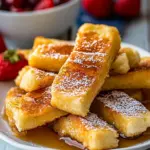
Baked French Toast Sticks
I make these baked French toast sticks whenever I want a hands-on breakfast that’s mostly effortless. They bake in a single layer, require only a few bowls, and please both kids and adults. You get a crisp exterior, tender center, and that warm cinnamon-sugar flavor without standing over a skillet.
The method uses Texas toast for thick, pillowy sticks that soak just enough of the custard. Little prep, dependable results. I’ll walk you through what to buy, the exact steps, equipment, troubleshooting, and smart swaps so you can make this recipe exactly or tweak it for your pantry.
Ingredients

- 2 Tbsp granulated sugar — balances the cinnamon and adds a light caramelized sweetness to the top.
- 1 tsp ground cinnamon — provides the classic warm spice; evenly coats the sticks when mixed with sugar.
- 1 cup whole milk — adds richness to the custard and helps create a tender interior.
- 4 large eggs — the structure and custard base; whisked well for even coating.
- 1 tsp vanilla extract — lifts the flavor with a subtle, homey aroma.
- 1 pinch salt — enhances sweetness and rounds flavors.
- 8 slices Texas toast bread — thick slices that make perfect sticks; they hold custard without falling apart.
- 2 Tbsp butter, melted, plus more for serving if desired — brushed on for browning and flavor; optional extra at serving for richness.
- Maple syrup, for serving — classic dipping partner; serves as the finishing sweetener at the table.
What to Buy
Shop for Texan-style thick-cut bread labeled “Texas toast” if you can; its thickness is what gives the sticks their soft center without getting soggy. If your store offers a bakery-style Texas toast, grab that for better crumb and less processing. Otherwise a sturdy, thick-sliced white bread will work in a pinch.
Whole milk and large eggs are the backbone of the custard. If you prefer richer results, choose a higher-fat milk or fresh, large eggs. For the spice, stick to ground cinnamon—freshly ground is nice but not necessary. Grab real vanilla extract, not imitation, for the best aroma.
For equipment, parchment paper, a reliable baking sheet (18 x 13-inch if possible), and a basting brush will make the process cleaner and easier. You’ll find the exact equipment list later in the post.
Make Baked French Toast Sticks: A Simple Method
- Preheat oven to 350°F. Line an 18 x 13-inch baking sheet with parchment paper.
- In a small bowl, whisk together 2 Tbsp granulated sugar and 1 tsp ground cinnamon; set aside.
- In a medium bowl, vigorously whisk 1 cup whole milk, 4 large eggs, 1 tsp vanilla extract, and 1 pinch salt until very well blended.
- Stack the 8 slices Texas toast and cut each slice into three even strips to make 24 sticks. (You can layer a few slices to cut several at a time.)
- Working a few sticks at a time, dip each bread stick into the egg mixture, allowing excess to run off back into the bowl, then transfer the coated sticks to the prepared baking sheet. Arrange them so they fit closely but with a little space between sticks.
- Using a basting brush, brush the tops of the arranged sticks lightly with 1 Tbsp melted butter.
- Sprinkle the tops evenly with half of the cinnamon-sugar mixture.
- Bake in the preheated oven for 13 minutes.
- Remove the baking sheet, flip each french toast stick to the opposite side, brush the tops lightly with the remaining 1 Tbsp melted butter, and sprinkle evenly with the remaining cinnamon-sugar mixture.
- Return to the oven and bake until cooked through and golden, about 13 to 18 minutes more. Let the sticks cool a few minutes on the baking sheet, brush lightly with a little more melted butter if desired, and serve warm with maple syrup for dipping.
Why This Baked French Toast Sticks Stands Out

There are a few reasons I reach for this baked version instead of frying sticks on the stovetop. Baking lets you handle three dozen bites at once without babysitting a skillet. The result is consistently golden and evenly cooked because the oven surrounds the sticks with steady heat.
Using Texas toast makes a big difference. The thicker slices soak up enough custard to be tender inside while keeping a firm, slightly chewy structure that crisps on the edges. The two-stage bake and flip (with butter and cinnamon-sugar before and after) create a more defined crust and a warm, spiced sugar finish.
Finally, the method is forgiving. You don’t need precision timing to get good results—just watch for golden color and an internal set. It’s a practical recipe for busy mornings and for feeding a crowd.
Swap Guide

Want to change a component? Here are straightforward swaps and what to expect.
- Milk: Swap whole milk for 2% or a plant-based milk like almond or oat if you need dairy-free. Texture will be slightly less rich with lower-fat milks; plant milks may yield a thinner custard so watch soak times.
- Bread: If you can’t find Texas toast, use any sturdy, thick-sliced bread—brioche or challah are excellent for richness. Thin sandwich bread will get soggy faster.
- Butter: Use melted coconut oil or a neutral oil for dairy-free browning. The flavor profile will shift slightly but the sticks will still brown well.
- Sugar & spice: Brown sugar in place of granulated sugar adds molasses notes. You can add a pinch of nutmeg if you like, but cinnamon alone is classic and dependable.
Equipment Breakdown
These are the items that noticeably impact the result, and why I recommend them.
- Baking sheet (18 x 13-inch) — provides a single even layer so heat circulates freely and sticks bake evenly.
- Parchment paper — prevents sticking and makes cleanup fast. It also helps keep the bottoms from over-browning.
- Basting brush — lets you control how much melted butter goes on each stick; a quick sweep is all you need.
- Two mixing bowls — one small for cinnamon-sugar and one medium for the custard. You can reuse a bowl but having both speeds things up.
- Sharp knife and cutting board — for clean, even sticks. A serrated bread knife makes slicing layered slices easier and neater.
Watch Outs & How to Fix
Here are common issues and quick fixes so the batch turns out well every time.
- Problem: Soggy interior. Fix: Make sure bread is thick-sliced and doesn’t sit in custard too long. Dip quickly and let excess drip off before placing on the sheet. If your bread is fresh and very soft, consider toasting slices briefly before cutting.
- Problem: Too dark on the bottom. Fix: Use parchment and make sure your oven rack is centered. If bottoms brown faster than tops, rotate the pan halfway through the final bake and lower the temperature by 25°F next time.
- Problem: Dry or rubbery sticks. Fix: Overbaking is usually the cause. Start checking toward the shorter end of the final bake window (around 13 minutes) and watch for a golden color and firm but not hard interior.
- Problem: Uneven cinnamon-sugar coverage. Fix: Mix sugar and cinnamon thoroughly and sprinkle from a small spoon or shaker; do half before the first bake and the remainder after flipping to build an even layer.
Variations for Dietary Needs
These ideas keep the spirit of the recipe while addressing common dietary preferences.
- Vegan: Use a plant-based milk and a flax or chia “egg” replacement. Swap butter for melted coconut oil or vegan butter. Note: texture will be slightly different; press excess custard off the bread before baking.
- Gluten-free: Use a sturdy gluten-free bread that’s thick-sliced. Some gluten-free breads are more fragile, so handle gently when dipping and arranging.
- Lower sugar: Reduce the granulated sugar for the coating, or omit it and dust a light layer of powdered sugar at the table. The interior custard has no added sugar aside from the coating.
Cook’s Notes
Timing is your friend here. The recipe has two bakes: an initial set and a finish after flipping. The second bake ranges from 13 to 18 minutes because ovens and bread thickness vary. Start checking at 13 minutes and look for a golden color and a set interior.
Cutting the bread into three even strips makes handling faster and gives a nice bite-sized portion. If you want shorter sticks for dipping, slice each strip in half crosswise after baking. Serve warm; they’re best soon after they come out of the oven.
Storage Pro Tips
If you have leftovers, cool the sticks completely on a rack, then store in an airtight container in the refrigerator for up to 3 days. To reheat, arrange them on a baking sheet and warm in a 350°F oven for 8–10 minutes to restore crispness. A toaster oven works well for single servings and helps re-crisp edges.
For longer storage, freeze cooled sticks in a single layer on a tray until solid, then transfer to a freezer bag. Reheat from frozen in a 350°F oven for 12–15 minutes or until hot and golden.
Baked French Toast Sticks FAQs
Q: Can I assemble this the night before?
A: You can prep the cinnamon-sugar and custard, and cut the bread the night before. I don’t recommend dipping the bread and refrigerating it overnight; the bread can become overly soaked. Dip and bake the morning you serve for best texture.
Q: Will this work with stale bread?
A: Slightly stale or day-old Texas toast is actually fine and can hold custard well. If the bread is very dry, dip more quickly to avoid it falling apart.
Q: Can I skip the flip?
A: Flipping helps get an even golden finish on both sides and lets you add fresh cinnamon-sugar to the second side. If you’re short on time, you can skip the flip, but the top will brown less evenly.
Q: How do I know when they’re done?
A: The sticks should be golden and no longer jiggly in the center. Press lightly—if the center feels set and springs back, they’re done. The second bake time window allows for texture differences between ovens and bread.
See You at the Table
These baked French toast sticks are the kind of breakfast that lets you be present with people instead of stuck at the stove. Little hands can dip, kids can dunk, and adults can pour coffee. The technique is simple and forgiving, and the rewards are reliably delicious.
Make them on a weekend morning or for a casual brunch. Serve with warm maple syrup, extra melted butter, or a side of fresh fruit. If you try a swap or have a favorite tweak, tell me how it went—I love practical tips that actually work in a busy kitchen. Enjoy.
Baked French Toast Sticks
Ingredients
Ingredients
- 2 Tbspgranulated sugar
- 1 tspground cinnamon
- 1 cupwhole milk
- 4 large eggs
- 1 tspvanilla extract
- 1 pinch salt
- 8 slicesTexas toast bread
- 2 Tbspbutter melted, plus more for serving if desired
- Maple syrup for serving
Instructions
Instructions
- Preheat oven to 350°F. Line an 18 x 13-inch baking sheet with parchment paper.
- In a small bowl, whisk together 2 Tbsp granulated sugar and 1 tsp ground cinnamon; set aside.
- In a medium bowl, vigorously whisk 1 cup whole milk, 4 large eggs, 1 tsp vanilla extract, and 1 pinch salt until very well blended.
- Stack the 8 slices Texas toast and cut each slice into three even strips to make 24 sticks. (You can layer a few slices to cut several at a time.)
- Working a few sticks at a time, dip each bread stick into the egg mixture, allowing excess to run off back into the bowl, then transfer the coated sticks to the prepared baking sheet. Arrange them so they fit closely but with a little space between sticks.
- Using a basting brush, brush the tops of the arranged sticks lightly with 1 Tbsp melted butter.
- Sprinkle the tops evenly with half of the cinnamon-sugar mixture.
- Bake in the preheated oven for 13 minutes.
- Remove the baking sheet, flip each french toast stick to the opposite side, brush the tops lightly with the remaining 1 Tbsp melted butter, and sprinkle evenly with the remaining cinnamon-sugar mixture.
- Return to the oven and bake until cooked through and golden, about 13 to 18 minutes more. Let the sticks cool a few minutes on the baking sheet, brush lightly with a little more melted butter if desired, and serve warm with maple syrup for dipping.
Equipment
- Oven
- 18 x 13-inch baking sheet
- Parchment Paper
- Small Bowl
- Medium Bowl
- Whisk
- Basting Brush
- Knife
- Cutting Board
Notes
Recipe source: inspired byfood.com