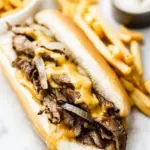
Philly Cheesesteak Recipe
Classic Philly cheesesteak with thinly sliced ribeye, caramelized onions, and a warm cheese sauce served on toasted buns.
Servings: 4 servings
Ingredients
Ingredients
- 1 cupshredded sharp cheddar cheese
- 1 cupshredded American cheese
- 1 tablespooncornstarch
- 1 teaspoongarlic granules
- 1 teaspoonground dry mustard
- 12 ouncesevaporated milk
- coarse salt to taste
- 3 tablespoonsclarified butter or ghee
- 2 peeled and sliced yellow onions
- 2 poundsthinly sliced ribeye steak
- 4 8 ” buns
- coarsesalt and pepper to taste
Instructions
Instructions
- Make the cheese sauce: In a medium saucepan combine 1 cup shredded sharp cheddar cheese, 1 cup shredded American cheese, 1 tablespoon cornstarch, 1 teaspoon garlic granules, 1 teaspoon ground dry mustard, 12 ounces evaporated milk, and coarse salt to taste. Whisk until smooth.
- Cook the sauce over low heat, stirring often, until the cheese is melted and the mixture is hot and thickened (about 4–6 minutes). Keep the sauce warm over the lowest heat, stirring occasionally.
- Heat a large frying pan or flattop over medium-high heat. Add 1 1/2 tablespoons clarified butter (or ghee). Add the 2 peeled and sliced yellow onions and cook, stirring occasionally, until lightly browned and soft, about 10 minutes. Transfer the cooked onions to a bowl and set aside.
- Wipe the pan if needed, return it to medium-high heat, and add the remaining 1 1/2 tablespoons clarified butter. Add the 2 pounds thinly sliced ribeye steak (work in a single layer or in batches if needed). Cook the steak 2–4 minutes, stirring or flipping, until lightly browned and cooked through.
- Add half of the cooked onions to the steak in the pan. Season with coarse salt and pepper to taste and stir until combined and heated through.
- Place the 4 buns, cut side down, on the other side of the pan or griddle (or on a separate hot surface) and heat until lightly toasted.
- Evenly divide the cooked steak mixture among the toasted buns. Top each with the remaining caramelized onions and spoon the warm cheese sauce over the top.
- Serve immediately.
Equipment
- Medium Saucepan
- large frying pan or griddle
- Bowl
Notes
Notes
To avoid a grainy cheese sauce, I highly recommend to keep the heat low and stir it frequently. If the sauce thickens too much, whisk in a splash of evaporated milk until it reaches the perfect consistency.
Flat-Top Advantage:
I love using a flat-top griddle for plenty of cooking space, but a large frying pan or cast-iron skillet works just as well.
Cheese Swap:
Skip the cheese sauce if you prefer and melt provolone directly into the steak—it blends right in for that classic gooey texture.
Essential Tool:
A metal spatula is a must for chopping, mixing, and flipping the steak as it cooks.
Better Cheese:
I always shred my own cheese for the best melt and texture—pre-shredded just doesn’t compare.
Easier Slicing:
Freezing the ribeye for 30 minutes makes it way easier to slice thin, and cutting against the grain keeps it extra tender.
Onions Matter:
I personally think caramelized onions are a must, and if you’re in Philly, you can order your cheesesteak “wid” (with onions) or “widout” (without onions).
Traditional vs. Custom:
Classic Philly cheesesteaks aren’t made with sautéed bell peppers and
mushrooms
but are common add-ins.
Topping Ideas:
Other popular cheesesteak toppings are a spoonful of
pizza sauce
, a sprinkle of mozzarella, hot cherry peppers, pickled jalapeños, and a drizzle of hot sauce.
Make-Ahead:
You can caramelize the onions and sear the meat 2 to 3 hours ahead of assembling the sandwiches. Keep them warm in a crockpot or a pan over low heat.
How to Store:
Transfer the meat, caramelized onions, and cheese sauce to separate airtight containers. They will keep it in the refrigerator for 4 to 5 days. The cooked meat and onions also freeze well for up to 2 months. Thaw them in the fridge before reheating.
How to Reheat:
Heat the desired amount of steak and onions in a small frying pan over low heat or in the microwave. The sauce can be warmed in a small saucepan over low heat, stirring occasionally.
To avoid a grainy cheese sauce, I highly recommend to keep the heat low and stir it frequently. If the sauce thickens too much, whisk in a splash of evaporated milk until it reaches the perfect consistency.
Flat-Top Advantage:
I love using a flat-top griddle for plenty of cooking space, but a large frying pan or cast-iron skillet works just as well.
Cheese Swap:
Skip the cheese sauce if you prefer and melt provolone directly into the steak—it blends right in for that classic gooey texture.
Essential Tool:
A metal spatula is a must for chopping, mixing, and flipping the steak as it cooks.
Better Cheese:
I always shred my own cheese for the best melt and texture—pre-shredded just doesn’t compare.
Easier Slicing:
Freezing the ribeye for 30 minutes makes it way easier to slice thin, and cutting against the grain keeps it extra tender.
Onions Matter:
I personally think caramelized onions are a must, and if you’re in Philly, you can order your cheesesteak “wid” (with onions) or “widout” (without onions).
Traditional vs. Custom:
Classic Philly cheesesteaks aren’t made with sautéed bell peppers and
mushrooms
but are common add-ins.
Topping Ideas:
Other popular cheesesteak toppings are a spoonful of
pizza sauce
, a sprinkle of mozzarella, hot cherry peppers, pickled jalapeños, and a drizzle of hot sauce.
Make-Ahead:
You can caramelize the onions and sear the meat 2 to 3 hours ahead of assembling the sandwiches. Keep them warm in a crockpot or a pan over low heat.
How to Store:
Transfer the meat, caramelized onions, and cheese sauce to separate airtight containers. They will keep it in the refrigerator for 4 to 5 days. The cooked meat and onions also freeze well for up to 2 months. Thaw them in the fridge before reheating.
How to Reheat:
Heat the desired amount of steak and onions in a small frying pan over low heat or in the microwave. The sauce can be warmed in a small saucepan over low heat, stirring occasionally.